Economic Presence
  • Home
  • Paradox found
    • Paradox found

Michael Woodford at Fed Conference 

10/8/2014

2 Comments

 
Andolfatto
If you were Chairman of the Federal Reserve, what sort of policy or policy intervention would you be favoring at this time, just endowed with the situation as it has developed to this point?

Woodford
It's obviously a very complex situation. In general, I wish the Fed were speaking more about the need for fiscal policy to take on more of the burden of trying to get the economy moving. I'm afraid that, to some extent, the Fed's desire to stress the fact that we still have tools, we haven't used all of our ammunition, has had unfortunate effects. Of course, the intention of that is to reassure the public. The feeling is that letting people be scared that maybe we're out of ideas would itself create uncertainty about the future that would be undesirable for the economy. And that's understandable. But I worry that it's had the undesirable effect of letting Congress off the hook a little too easily by letting them say, "The Fed still has lots of things they can do to take care of the situation, so we can play other games." And I think maybe the Fed would have helped the public debate if it had pushed back a little more on the view that everybody should be assuming the Fed will save everything.
2 Comments

Deflationary Pressures

10/3/2014

0 Comments

 
Via FT
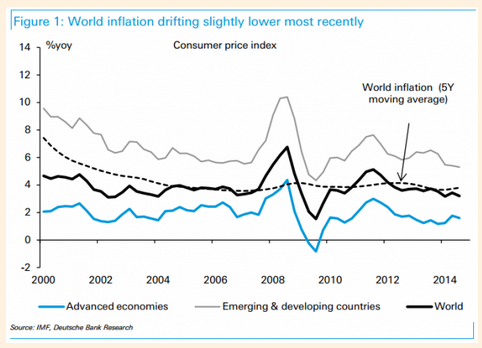
"Consider some of the global non-policy forces that might now be weighing on price inflation:

– Aging demographics, high debt loads, weak nominal wage growth and persistent output gaps in advanced economies.

– Slowing growth in emerging economies, as their catch-up period has stalled.

– The shale revolution and improving technologies across the energy landscape, along with weaker commodity price growth in recent years.

– Entrenched deflation in non-construction investment goods (and consumer durable goods) since the late 1990s.

– There continues to be a residual belief in most developed-world markets, resilient since the 1980s and the subsequent Great Moderation period, that central banks can reverse breakaway inflation. This makes it hard for inflation expectations, which can have a feedback effect on current inflation itself, from becoming too unanchored even if unexpectedly aggressive demand-side policies are pursued. (The same expectation of stability also probably helps prevent deflation.)
.......


Subdued inflation obviously isn’t a permanent state. Looking only at the broad global trends conceals tremendous variation between countries. Some economies are also more vulnerable to specific global pressures, and to currency fluctuations, than others. Domestic policy still matters most, and even when it is inadequately aggressive, plodding growth can still slowly lead an economy back towards full employment eventually, provided it goes on for a while.

But the problem that comes with running a low-pressure economy for too long is that the expansion stays precarious. Geopolitical (not to mention domestic-political) risks are always looming. The opening months of the year demonstrated that even the weather can knock the strengthening US economy off its growth path, if temporarily. Another slowdown in growth, or even a downturn, becomes more likely if negative cyclical forces reassert themselves. The same applies if measurement flaws lead policymakers to believe that their economies are stronger than they really are, prompting complacency. Finally, the delay itself is problematic given the possible hysteresis effects of people and capital going unused, lowering the slope of potential growth.

Look at the set of trends listed above, and you might recognise that many of them are diametrically the opposite of those that prevailed in the 1970s. A few of them are also quite obvious reversals from the decade leading up to the recent crisis. The point is not that policy can do nothing to countervail these global forces; it can do plenty. The point is simply that when the world changes, so does the mix of influences on price behaviour."

Picture
0 Comments

Speaking of inequality deniers -here is a considered response to John Cochrane

10/3/2014

0 Comments

 
By Tony Yates.
0 Comments

Other Popular Economists are starting to call out Scott Winship

10/3/2014

0 Comments

 
Scott Winship and his intellectual brethren have been first denying then minimizing the impact of growing inequality for years. I have said many many times on these pages that he/they are being intellectually dishonest Here is my first post on the matter 21/2 years ago.

This from Matt Yglesias

"And then something enormously predictable happened. Any time a depiction of growing inequality in the United States becomes popular, people who believe that increased inequality isn't bad, even if it's real, start arguing that it isn't real either. Scott Winship is one of the brightest lights of that school of thought, so he presented a long series of quibbles with both the Saez/Piketty data and Tcherneva's presentation of it which he framed as a debunking of their claims."

Matt ends with:


The bottom line is that while there is lots of room for arguing about the details of data selection, the conclusion that inequality is growing is not an eccentric discovery made by two French economists working with a particular source of income data. The broad trend is clear from a diverse set of data. Median household income growth has badly lagged per capita GDP growth, corporate profits as a share of national income have risen, and stock markets have reached record highs.

Outside the sphere of political debate, you also see the real world impact of inequality. Merrill Lynch recommends an investment strategy to its clients based on the growing economic clout of plutocrats, Singapore Airlines is now selling $18,400 first class cabin tickets, and observers think Apple is going to start selling a $10,000 watch. Conversely, Walmart is now primarily worried about competition from dollar stores. The executives at these companies are not hysterical liberals trying to drum up paranoia about inequality, they are trying to respond to real economic conditions — conditions that have entailed very poor wage growth paired with decent returns for those proserous enough to own lots of shares of stock.

Looping back to the beginning, the most striking fact about the entire dispute is that Winship himself does not disagree that inequality is at a very high level and that it has risen since the Reagan Revolution. He simply thinks it's wrong to obsess over this, and therefore that it's wrong to try to think up ways to dramatize it. But if you think that America is slipping into a doom loop of oligarchy then naturally you will want to dramatize the trend. Tcherneva's chart does that very well, which is exactly why it's so controversial.

0 Comments

Noah Smith thinks Japan will likely have to monetize its debt

10/3/2014

0 Comments

 
Bloomberg. He wonders what that means? So do I (on both points).
0 Comments

Krugman takes on the right wing view that austerity saved the Canadian Economy

10/3/2014

4 Comments

 
Points out the BoC was able to lower interest rates to mitigate the costs of austerity and that Canada continues to have a larger government sector  than the US.
4 Comments

Slate Debunks the 10 000 hours to mastery rule of thumb

10/3/2014

0 Comments

 
"Wouldn’t it be better to just act as if we are equal, evidence to the contrary notwithstanding? That way, no people will be discouraged from chasing their dreams—competing in the Olympics or performing at Carnegie Hall or winning a Nobel Prize. The answer is no, for two reasons. The first is that failure is costly, both to society and to individuals. Pretending that all people are equal in their abilities will not change the fact that a person with an average IQ is unlikely to become a theoretical physicist, or the fact that a person with a low level of music ability is unlikely to become a concert pianist. It makes more sense to pay attention to people’s abilities and their likelihood of achieving certain goals, so people can make good decisions about the goals they want to spend their time, money, and energy pursuing. Moreover, genes influence not only our abilities, but the environments we create for ourselves and the activities we prefer—a phenomenon known as gene-environment correlation. For example, yet another recent twin study (and the Karolinska Institute study) found that there was a genetic influence on practicing music. Pushing someone into a career for which he or she is genetically unsuited will likely not work.

The second reason we should not pretend we are endowed with the same abilities is that doing so perpetuates the myth that is at the root of much inaction in society—the myth that people can help themselves to the same degree if they just try hard enough. You’re not a heart surgeon? That’s your fault for not working hard enough in school! You didn’t make it as a concert pianist? You must not have wanted it that badly. Societal inequality is thus justified on the grounds that anyone who is willing to put in the requisite time and effort can succeed and should be rewarded with a good life, whereas those who struggle to make ends meet are to blame for their situations and should pull themselves up by their own bootstraps. If we acknowledge that people differ in what they have to contribute, then we have an argument for a society in which all human beings are entitled to a life that includes access to decent housing, health care, and education, simply because they are human. Our abilities might not be identical, and our needs surely differ, but our basic human rights are universal."
0 Comments

Stop Complaining

10/3/2014

0 Comments

 
My Brother was an example of this to me. He did not complain about his terminal illness and accepted his death sentence with grace.


0 Comments

Scott Adams (Dilbert) talks about how to succeed in life

10/3/2014

0 Comments

 
Keep Trying. Goals are bullshit - systems are the way to approach life.
0 Comments

Regulatory Capture by Goldman Sachs at the Fed

10/3/2014

0 Comments

 
Fed Employee attempts to regulate  Goldman Sachs and is fired after she refuses to back down on her recommendations. She secretly tapes meetings with management and Goldman. Her career ruined; Goldman Sachs conducts business as usual. Courtesy This American Life.
0 Comments
<<Previous
Forward>>

    Author

    Karl Pinno

    Categories

    All
    60 Minutes
    Abnormal Returns
    Academic Publishing
    Advice For Econ Students
    Age
    Aid
    Algo Trading
    Aluminum
    Argentina
    Assortive Matching
    Austerity
    Bank Of England
    Behavioural Economics
    Bio Weapons
    Bis
    Bloomberg
    Bonds
    Bono
    Book Of Mormon
    Brain
    Brazil
    Brics
    Bridgewater Associates
    Buffet
    Calgary
    Canada
    Capital Flight
    Carola Binder
    Cds
    Central Banks
    Chainmail Bikinis
    Chanos
    Child Rearing
    China
    Chris Martenson
    Christmas Wishlist
    Climate Change
    College Humor
    Commercial Banks
    Commodities
    Community
    Computer Programming
    Confirmation Bias
    Conservatism
    Conservative
    Constructive Ambiquity
    Consumer Confidence
    Copper
    Corporate Lending
    Counterparty Risk
    Creativity
    Credit
    Culture
    Cwb
    David Einhorn
    David Rosenberg
    Debate
    Debt Crisis
    Deflation
    Demographics
    Depression
    Development
    Dragons
    Dr. Ed's Blog
    Econ Blogs
    Economics
    Ecri
    Education
    Electricity
    Eurasia Group
    Eurozone
    Excercise
    Externalities
    Falkenblog
    Ferguson
    Fertility
    Filtering
    Financial Crisis 2008
    Financial Engineering
    Financial Reform
    Financial Repression
    Financial Research
    Fiscal Policy
    Fiscal Stimulus
    Fisher
    Fixed Income
    Flood
    Food Prices
    Frank And Cook
    Fraud
    Freidman
    Ft
    Game Theory
    Gender
    Generalist
    George Soros
    Get Smart
    Giffen Good
    Global Banking
    Global Economy
    Gmo
    Godfather
    Gold
    Goldman Sachs
    Great Careers
    Greece
    Greenlight Capital
    Happiness
    Hayman Capital Management Lp
    Hbo
    Health
    Hedge Funds
    Homosexuality
    Housing Market
    Hubbard
    Hugh Hendry
    Hussman
    Ian Bremmer
    Imf
    Inception
    Income Smoothing
    India
    Inequality
    Inflation
    Inflationary Expectations
    Inside Job
    Interest Rates
    Interfluidity
    Intuition
    Inventories
    Iran
    Iraq
    Italy
    Janusian Thinking
    Japan
    Jordan Peterson
    Jp Morgan
    Judgement
    Kalecki Equation
    Krugman
    Kyle Bass
    Larry Smith
    Larry Summers
    Lehman Brothers
    Levitt
    Liberal
    Lonely Island
    Luck
    Macro
    Macro Intro
    Macro Predictions
    Management Consulting
    Marginal Revolution
    Market Design
    Market Monetarism
    Marx
    Matt Taibbi
    Mercantilism
    Michael Portillo
    Milton Friedman
    Mircea Eliade
    Mish
    Mishkin
    Monetary Policy
    Monetary Stimulus
    Multipliers
    Mundell
    Music
    Nanex
    Nfl
    Noahpinion
    Nobel Price In Economics
    Oil Price Volatility
    Oil Production
    Omitted Variable Bias
    Optimism Bias
    Overcomingbias
    Palantir
    Pettis
    Phillips Curve
    Placebo
    Podcasts
    Poker
    Poland
    Politico
    Politics
    Populism
    Portfolio Management
    Positivism
    Prisoner's Dilemma
    Productivity
    Psychology
    Publishing
    Quality
    Quantitative Easing
    Race
    Rand Paul
    Ray Dalio
    Rbc Theory
    Real Interest Rates
    Reality Tv
    Recession
    Redistributionist Reform
    Regulators
    Regulatory Capture
    Remembrance Day
    Research
    Richard Wilkinson
    Riots
    Risk
    Risk Taking
    Robots
    Roubini
    Russia
    Ryan
    Sachs
    Salt
    Saudi Arabia
    Sec
    Seth Klarman
    Shadowbanking
    Shiller
    Signaling
    Smes
    Snap
    Social Policy
    Social Unrest
    Society
    Sorkin
    Soros
    S&P
    Spain
    Specialization
    Speculation
    State Sponsored Terrorism
    Status
    Steve Jobs
    Steven Keen
    Stress
    Structural Unemployment
    Structure Finance
    Sugar
    Suicide
    Svars
    Systemic Risk
    Tax
    Taylor Rule
    Technology
    Ted
    Television
    The Clash
    The Economist
    The Wire
    Thinking
    Thoureau
    Trade
    Trilemma
    Turkey
    Tyler Cowen
    U2
    Unemployment
    Us 2012 Election
    Us Economy
    Us Foreign Policy
    Velocity
    Volatility
    Welfare
    Williams
    Words
    Work
    Writing
    Zerohedge
    Zig Ziglar

    Archives

    November 2017
    October 2017
    March 2017
    January 2017
    March 2016
    February 2016
    January 2016
    December 2015
    November 2015
    October 2015
    September 2015
    August 2015
    July 2015
    June 2015
    May 2015
    April 2015
    February 2015
    December 2014
    November 2014
    October 2014
    September 2014
    August 2014
    July 2014
    June 2014
    May 2014
    April 2014
    March 2014
    February 2014
    January 2014
    December 2013
    November 2013
    October 2013
    September 2013
    August 2013
    July 2013
    June 2013
    May 2013
    April 2013
    March 2013
    February 2013
    January 2013
    December 2012
    November 2012
    October 2012
    September 2012
    August 2012
    July 2012
    June 2012
    May 2012
    April 2012
    March 2012
    February 2012
    January 2012
    December 2011
    November 2011
    October 2011
    September 2011
    August 2011

    RSS Feed

Powered by Create your own unique website with customizable templates.
